Showcase 2: Global Digital Services Finland Study Abroad
This showcase highlights my favorite Honors experience, a study abroad trip to Finland in the spring of my journey year. The artifacts in this showcase include a website developed over a spring class and a design reflection written while in Finland.
Introduction
In the spring of 2025, the second semester of my junior year, I took part in a study abroad program held by the Luddy School of Informatics, Computing, and Engineering that focused on digital services in Finland. Over the course of the spring semester, I collaborated with and helped lead a team of students from both IU Indianapolis and Haaga-Helia University of Applied Sciences in Helsinki on a web development project. Together, we chose a topic related to the theme of artificial intelligence—AI misinformation on social media—and designed and developed an accessible, interactive website. At the end of the semester, I traveled with a cohort of IU Indianapolis students to Finland for two weeks, where we met up with our team members and analyzed services across libraries, informational institutions, and historical sites. Below, you can view our completed website, ‘Factbook’, as well as photos and excerpts from my reflection on museums and design in Finland.
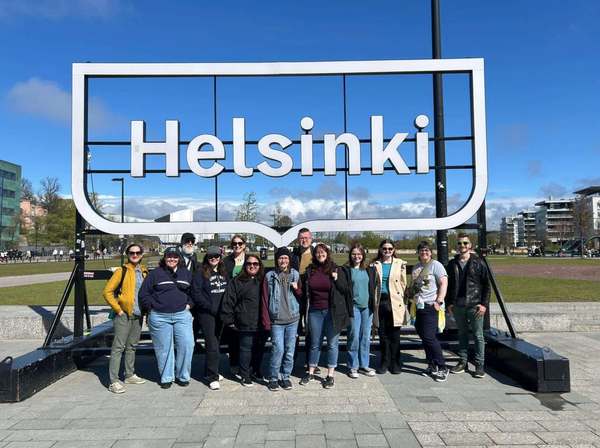
Photo of IU Indianapolis study abroad class students and instructors near Helsinki Central Library Oodi.
I incorporated responsive design techniques into the Factbook website, making the page easy to navigate across all device types, with different layouts for desktop and mobile screens.

Factbook site viewed on desktop.

Factbook site viewed on mobile.
Explore the Factbook website below or at this link.
Skills Development
Over the course of the spring project, I developed many skills, both technical and nontechnical. Although I had learned the basics of HTML and CSS previously, through this course and project, I learned how to design grid layouts for responsive websites that function on both desktop and mobile devices and how to ensure sites are accessible for by using semantic HTML and checking color contrasts. The opportunity to collaborate with team members across great distances helped me to improve my leadership and collaboration skills by scheduling meetings, clearly documenting project plans and tasks, and finding multiple ways to communicate information so everybody could stay on the same page despite the major time zone difference. During the study abroad trip, I learned how to more deeply analyze the design of sites and services, as well as how to apply my findings back to my own work.
"In my observations, I have felt that Finnish design principles are similar to those I am used to from the US, but are generally held to more strongly. For example, many unique design elements I have seen in Finnish architecture and items make them more engaging without detracting from the functionality. As I observed in the Helsinki Design Museum and the Arabia Design Center, many items that people interact with frequently like tableware tend to stick closely to the expected design while adding new visual elements, whereas designers often do more freeform work with more static objects like vases.
The only major exception that I have noticed was in the Arabianranta neighborhood, where the art installations often felt awkward next to paths or playgrounds when they could have been combined, probably due to the mandated art installations being placed by building owners who may not have control over the paths. Although I do not have specific examples in mind, I believe form and function end up feeling disconnected in design in the US more often than not, even though it is desired for them to be aligned. However, in Finland, this disconnect has felt like an exception rather than the rule, and most design has been remarkably practical."


Photos of artwork from the Arabianranta neighborhood in Helsinki.

Photos of tableware from the Arabia Design Center neighborhood in Helsinki.
"My takeaways for how I could incorporate Finnish design concepts into my work is by providing interactive elements that improve engagement with the subject matter rather than distracting from it. This is a principle that I have thought about before, but the ways in which the Helsinki Design Museum encouraged visitors to reflect on material through prompts and think about the design process by handling items themselves has made the importance of getting users meaningfully involved even more clear. Also, when working on digital design in the future, I plan to consider more carefully the amount of freedom to give users with engagement and interactivity, as I may have stricter expectations due to my design experiences in the US than others from around the world."
Reflection
Looking back, I am extremely grateful that I had the opportunity to participate in this study abroad course and trip. The experience allowed me to deepen my knowledge of and experience with web development and get more involved in the design aspects of development. After leading a group of students with a variety of technical experience, data and library science students at IU Indianapolis and new pre-major students at Haaga-Helia University of Applied Sciences, I believe I will be even more successful when collaborating with different kinds of teams in the future. I am quite proud of the website we built over the spring despite the challenges of distance collaboration. During the trip to Finland, I learned so much about design and information organization, while also exploring a variety of cultural sites and becoming immersed in the local culture. This experience has helped to broaden my worldview, strengthen my design sense, and improve my self-confidence and independence, which will be valuable throughout my life and future career.